Wealth management
Investments that make a difference: how Switzerland promotes progress
Investments that make a difference: how Switzerland promotes progress

Impact investing combines financial returns with social impact. In Switzerland, this is more than just a trend – it’s a tradition. Banks and international organisations are creating a stable ecosystem that offers favourable conditions for impact-oriented investing.
Money is never neutral. It plays a decisive role in determining which ideas take off, which technologies are developed and which companies succeed. This is where impact investing comes in. The aim is to deploy financial resources in such a way that, alongside a return on investment, they also generate a measurable social or environmental benefit.
Microcredits are one example of this. Investors can use their money, for instance, to support women in setting up a sewing workshop or to finance the purchase of seed for smallholder farmers. In return, they receive a share of the interest payments made by the micro-entrepreneur or smallholder.
Swiss impact investing since 1995
Switzerland is one of the pioneers of impact investing. As early as 1995, the Federal Office for Foreign Economic Affairs (now the State Secretariat for Economic Affairs, SECO) invested in Profund, one of the first commercial investment funds for microloans.
This combination of philanthropy and investment proved successful: the fund provided capital to just under a million micro-enterprises and achieved a return of seven percent over its 10-year term.
Today, impact investing is enjoying ever-increasing popularity. Over the past five years, the investment volume of the global market has doubled. And Switzerland is making a significant contribution to this. Around 12 percent of the global assets under management of private asset impact funds – that is, impact-oriented funds for unlisted investments – are managed in Switzerland. Only the US holds a higher share, at 26 percent.
Blended finance: pooled financial strength
It is no coincidence that Switzerland is now one of the key players in impact investing. On the one hand, it has a long tradition of international development cooperation. On the other, the Swiss financial centre is one of the world’s leading centres for asset management.
This ecosystem has given rise, for example, to the SDG Impact Finance Initiative (SIFI) – a collaboration between the Swiss Agency for Development and Cooperation (SDC), SECO and the UBS Optimus Foundation. The initiative has set itself the goal of mobilising 1 billion Swiss francs. This money is intended to support companies that contribute to achieving the United Nations Sustainable Development Goals (SDGs).
The SDC, SECO and UBS are supporting the fund platform not only with expertise but also with around 30 million Swiss francs in capital. Under a financing model known as blended finance, public and philanthropic funds assume a significant portion of the risk, thereby creating incentives for institutional and private investors to participate in projects that would otherwise be difficult or impossible to finance.
From microloans to solar parks
Banks play a growing role in impact investing by mobilising additional private capital through investments made by the banks’ own foundations, as in the case of SIFI. They also develop their own investment products and solutions that enable private clients in particular to invest effectively.
In this way, banks are actively shaping the market, with the result that impact investing today encompasses far more than just microloans. It also includes social and green bonds, as well as sustainable infrastructure funds. And other areas, such as biodiversity, are emerging.
At the same time, the involvement of financial institutions is also changing the profile of investors. Today, impact investing is no longer limited to pension funds, foundations and high-net-worth individuals. Banks are also paving the way for clients with smaller assets to make impact-oriented investments. One example is Migros Bank, which, in partnership with the fintech firm Inyova, facilitates direct investments in renewable energy projects.
Sustainable investments can also have an impact
Despite the growing market, impact investments remain a niche: only around 1 percent of all assets under management worldwide are demonstrably allocated to impact-oriented investments. By comparison, the sustainable investments market accounts for 13 percent.
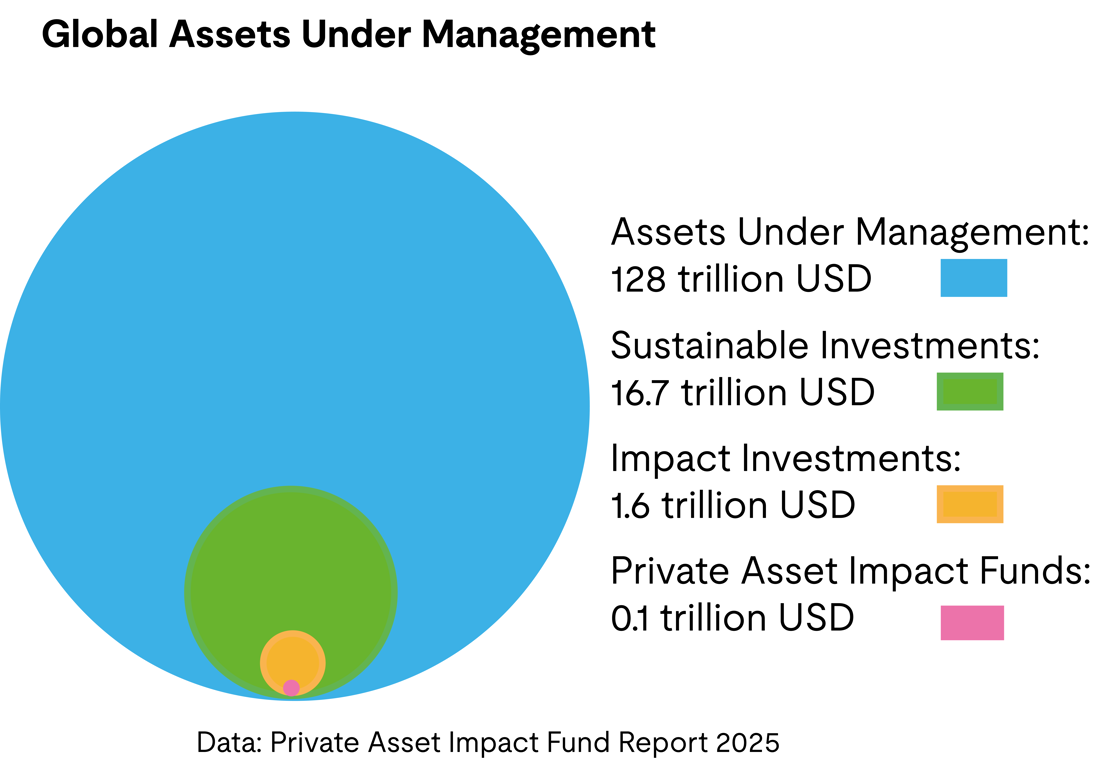
To properly understand the relationship between the different investment categories, it is important to know that, for an investment to be labelled as impact investment, a measurable environmental or social impact must be demonstrated. However, this does not necessarily mean that sustainable investment strategies do not have such an impact.
More than half of the investment funds offered by all Swiss banks are sustainable. Sixty-nine percent of funds are channelled into sustainable funds, meaning that these are growing faster than conventional ones. This shows that customers want to invest their capital consciously in a way that has a positive impact – whether or not this is accompanied by detailed impact reporting.