Mortgages
How mortgages support the energy transition
How mortgages support the energy transition
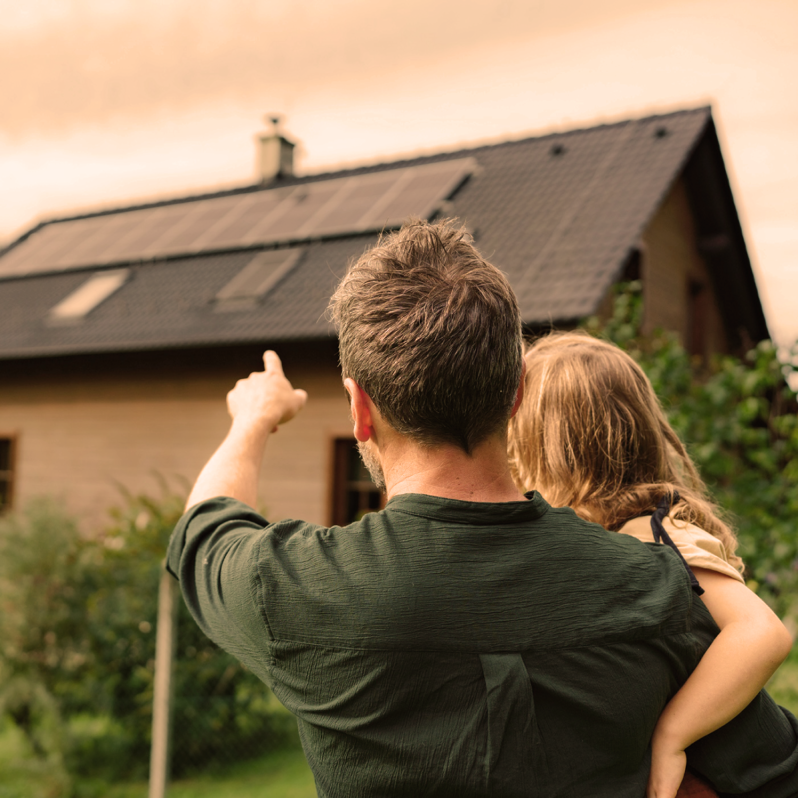
By financing energy efficiency in buildings, banks are creating momentum for a green chain reaction.
Anyone who builds or renovates quickly realises that sustainable solutions are often more expensive than traditional ones. For example, building a house to the Minergie standard costs around 3% more on average.
At the same time, there is an increasing obligation to ensure energy efficiency in the building sector in line with Switzerland's net-zero target for 2050. This is because buildings currently account for around a quarter of CO2 emissions and around 40% of energy consumption.
Estimates suggest that investments of several billion Swiss francs will be needed to achieve the necessary climate compatibility and energy efficiency. However, the renovation rate – currently one percent per year - is too low.
Mortgages in the green range
Banks are a key part of this transformation towards greater sustainability: they finance around 86% of all construction loans and provide targeted incentives through ‘green’ mortgages and loans.
This ‘green’ financing offers customers interest rate discounts for sustainability when purchasing or renovating real estate. As a criterion, banks usually use certification by the Minergie energy label or the cantonal building energy certificate (GEAK).
According to the Swiss Sustainable Lending Monitor, in recent years the interest rate on a ‘green’ mortgage has been on average just over a quarter lower than that of an average fixed-rate mortgage with a term of 10 years.
An investment that pays off
With ‘green’ mortgages, many banks are helping to lower the financial barriers to sustainability. At the same time, advisory services such as renovation calculators support well-informed decisions. Everyone benefits from this service: in the long term, the investment pays off for both homeowners and banks.
That’s because energy-efficient houses are cheaper to run, achieve higher sales and rental prices, and are less likely to lose value due to stricter regulations. And that also significantly reduces the risk of mortgage defaults for banks.
Sustainable value creation for the climate and the economy
In addition, environmentally friendly mortgages trigger a green chain reaction. They allow banks to issue ‘green’ bonds, which in turn enable pension funds, for example, to invest in sustainability.
Last but not least, mortgages provide important impetus for the entire economy: the construction sector accounts for around one tenth of Switzerland's total production value. Focusing on resource efficiency and innovation in this area not only increases value creation, but also improves the country’s long-term prospects.
Swiss Bankers Association self-regulation for sustainable buildings
In 2022, the Swiss Bankers Association (SBA) issued guidelines for promoting energy-efficient mortgages. These came into force in 2024 and are binding for all members of the Swiss Bankers Association.
The guidelines stipulate that banks must actively inform their customers about energy efficiency when advising them on mortgages. They also state that the terms and conditions of mortgages for sustainable properties may be adjusted relative to conventional mortgages.
According to a study by PWC and WWF, most of the largest Swiss banks (13 out of 15) offer discounted financing models. In addition, some banks have set targets for the decarbonisation of their mortgage business that are in line with science-based reduction pathways.
Following the guidelines, some banks have developed processes and online tools to actively address sustainability in buildings. This is having an effect: according to the PACTA Climate Test Switzerland 2024 by the Federal Office for the Environment (FOEN), it has already led to an increase in energy efficiency assessments by banks.